


Metal
Mastodon: “When we deal with darker subject matter, we’re always trying to create something beautiful out of something dark.”
In our latest Cover Story, Mastodon’s Troy Sanders discusses ‘Marrow Deep’, grief, Brent Hinds, renewed unity and the band’s next chapter together.

For Mastodon, Marrow Deep arrives from one of the most difficult periods in the band’s history. Following the departure and subsequent death of longtime guitarist Brent Hinds, alongside the loss of drummer Brann Dailor’s mother, the Atlanta band entered the writing process carrying grief, uncertainty and the weight of more than two decades spent together. Rather than stepping away, however, Troy Sanders, Bill Kelliher and Dailor found themselves surrounded by an unexpected abundance of new material and a renewed sense of purpose.
That momentum was strengthened by the arrival of guitarist Nick Johnston and keyboardist João Nogueira, expanding Mastodon into a five-piece and bringing a new energy into both the studio and live environment. With a wealth of demos to work from, the band approached the record collaboratively, while Sanders and Dailor channelled the emotional fallout of the previous year directly into the lyrics. For Sanders, that process became deeply therapeutic, transforming grief, regret and reflection into something he hopes can ultimately offer listeners the same sense of release.
In our latest Cover Story, V13 sits down with Troy Sanders to discuss the making of Marrow Deep, the aftermath of losing Brent Hinds, the arrival of a new lineup and why this record feels like a rebirth rather than a reset. He also reflects on friendship, guilt, collaboration, the support Mastodon received from musicians including Josh Homme and Geezer Butler, and why the band’s future in 2026 is defined by unity, perseverance and a shared determination to keep moving forward.
This record came from a very difficult period for the band. What were the conversations like around making a new album, the themes you wanted to explore and facing the grief and challenges you had been through? How did all of that shape what you wanted this record to be?
“The way it took shape was quite natural, even with all the surrounding tragedy and darkness. First and foremost, the core of the band — Bill Kelliher, Brann Dailor and myself — had reached a very difficult point when we parted ways with Brent in February 2025 after twenty-five years together. At the same time, we were nearly four years removed from Hushed and Grim, so we were also very excited about making a new record when the time was right. Thankfully, everything came together as smoothly as it did. Six months after separating from Brent, we were in the studio recording a new album in September.
We had all the pieces in place in a way that felt natural, authentic and exciting, with Nick Johnston on guitar and João Nogueira on keys. All five of us had a lot of music written, song structures and demos we were excited about, so there were equal parts excitement and uncertainty. Brent had been our guy. We’d experienced so much together around the world, and after twenty-five years and ten albums, we were suddenly going to make one without him. Change was in the air, but we had no intention of slowing down or doing anything else with our lives. We realised this was going to be one of the most important records of our lives.”
Was the amount of material you already had a big part of what gave you the confidence to move forward?
“Absolutely. We had around thirty-two demos. Bill had a huge number of songs and ideas structured out, Brann had a lot of material written and Nick Johnston had a bunch of ideas too. Nobody was experiencing writer’s block. In fact, the music seemed to be pouring out more healthily than ever. That was probably the foundation of the confidence behind making the record. We weren’t scraping around for ideas or searching for songs because they were already there. During the touring and writing period through 2025 and into 2026, including the European run in July, Bill brought his mobile Pro Tools setup with him.
Every day we would sift through ideas, add more material and really start honing in on what the record was going to become. Everybody was enthusiastic, willing and able, and that’s when great ideas become reality. The energy moving forward was there, but everything still felt strange because there was so much darkness around us. Brann’s mother died, we parted ways with Brent and then a few months later Brent died, only two weeks before we were scheduled to begin recording. It was heavy, confusing and frustrating, but I’m glad nobody decided to hold off. We already had studio time booked with Kurt Ballou and Patrick Berger, so we kept moving forward.”
“The energy moving forward was there, but everything still felt strange because there was so much darkness around us.”
How did the lyrical side of the record reveal itself through everything that was happening?
“Brann and I are the lyricists in the band, and we’ve always felt compelled to get personal with the lyrics. There’s a real sense of pride in doing that because, especially with this record, writing helped us process the emotions underneath the umbrella of grief. There are so many different facets to grief, and it takes time to understand where you are and why you’re feeling a certain way. Sometimes it changes on a daily basis. Putting those thoughts onto paper and eventually taking them into the vocal booth was incredibly helpful. It was therapeutic for both of us. Previous records like Hushed and Grim, Emperor of Sand and Crack the Skye also touched on personal and tragic events in our lives, and we believe that kind of writing is authentic not only to us but relatable to anybody who wants to listen.
We’re simply human beings. We’re not bigger or better than anybody else, and sometimes the music connects with people, helps them process something or gives them an escape they can return to. Brann and I didn’t sit down in January 2025 intending to write an album full of dark or tragic lyrics. But once Brann’s mother died and we had to part ways with Brent, the direction became pretty clear. Then when Brent passed away a few months later, we didn’t even need to discuss it. It was obvious that we were going to deal with the sadness, grief, frustration and everything else that came with it.”
You’ve said previously that, in terms of your relationship with Brent, you always felt there might one day be that phone call. Thinking something like that could happen and then actually receiving the news must be two very different things. What was the reality and aftermath like?
“It was incredibly sad. I’ve said before that, prior to Brent’s passing, there were two people in my phone where I would have been devastated to receive that phone call, but I wouldn’t necessarily have been shocked because of the way they lived their lives. Sadly, that happened with Brent in August 2025. I hope this doesn’t sound cold or callous, because I was devastated and I still am, but I wasn’t surprised. I was terribly saddened.”
I recently spoke with another band who had been through a similarly difficult period after around twenty-five years together. They felt those losses and challenges had ultimately brought them closer. Can you relate to that? How has the relationship between the three of you changed?
“The core of Mastodon — Bill, Brann and myself — is as tight now as we’ve ever been, and we’re still continuing to grow together, which is wonderful. There are many things I’m proud of with this record: Nick’s performances, Brann’s vocals, the guitars, the songs, the artwork and everybody’s contributions. But the thing I’m proudest of is that during such uneasy and dark times, all five band members were in the studio in Atlanta throughout September, present, energetic and excited to contribute to the songs for the greater good of Mastodon. We’re no longer a four-piece; we’re a five-piece. All five of us were in the control room, on standby, happy to be there and willing to help.
That overall energy is something we had been missing on some of the previous records. There were times in the past when you might be bummed out and not want to spend six, eight or ten hours in the studio, but you did it because something productive would eventually happen and make the day worthwhile. This time I would leave the studio thinking, “How fucking cool is that?” Everybody was there, excited to be part of it. All five of us shared the same motivation, energy and drive. You have to recognise moments like that as special while they’re happening because it’s wonderful when everybody is aligned.”

V13 Cover Story – Issue 135 – Mastodon
I saw you at Bloodstock last year and there seemed to be a particular energy around the band. After having the same core lineup for more than twenty years, what was it like bringing new faces into that environment?
“It was exciting, but it also felt like it could become a very daunting process. Our friends in Primus had just gone through thousands of drummer submissions and hundreds of auditions, so we knew it could potentially take a long time. I don’t think we ever wondered whether we would find the right person, it was more a question of when. We would have taken as much time as necessary. But it genuinely feels like fate was on our side because Nick Johnston simply appeared and clicked with us almost immediately. I still find that to be one of the most fascinating events of our career and my life.”
What do you think Nick brought to the band?
“First of all, he brought himself, which means a very humble, excited and loving human being. On top of that, he’s an incredible guitar player. He appeared when we needed him most. The first two days we spent together were simply about getting to know each other. There was no guitar playing because we needed to connect heart-to-heart first. He arrived in Atlanta on the day Brann’s mother died. When he got to the house, he immediately said, “I’ll leave.” We told him, “No, you should actually be here.” It was incredibly sad, but that was how the relationship started. It began in the most honest, open and heart-to-heart way possible on a very dark day. From that moment forward, Nick brought authenticity, renewed energy and devotion.
He said from the beginning, “I’m not here to fill Brent’s shoes because that’s an impossible task, but I’ll honour his music, songs and solos to the best of my ability as we move forward.” It felt like a blessing in disguise. We kept thinking, “Who are you? Are you real? How is everything magical and perfect happening at once?” And it stayed that way. He wasn’t full of it. After only a couple of days, it became clear that he was the real deal. I can’t speak highly enough of Nick and how seamless that transition felt. I kept waiting for something to go wrong because it almost seemed too good to be true, but it never did. Since the day we met him, it has felt like a beautiful sense of rebirth.”
Going onto the record itself, there are a lot of friends collaborating with you, including Josh Homme on the new single. What was the thought process behind bringing those people in? Did you have particular musicians in mind from the beginning?
“Usually those ideas reveal themselves while we’re listening back to the musical beds after the tracks have been recorded. Quite often it comes from Bill or Brann saying, “That section sounds like Neil Fallon’s voice would be amazing there,” or something similar. Most of the guests are musician friends we’ve built strong relationships with over the years. If we hear a particular voice or instrumentation that would suit a song, we reach out and ask whether they’d be interested in collaborating. More often than not, our friends are happy to do it.
I remember working on “Snakes for Dinner,” and during the ending Brann said, “That sounds like Josh could do something really cool over this.” He reached out, and Josh immediately said he’d love to work with us again. He did a song with us twenty years ago on Blood Mountain, so it was cool to come back together. It’s great that our friends are willing and able to contribute, and the more people you invite in, the more flavours and textures can appear on the record. Collaboration is a wonderful thing when people are genuinely excited to work together.”
Some of those friendships go right back to the early days of the band. Given everything you had been through, did that outpouring of support provide some light during the darker periods?
“It did. It was a nice flicker of light. Some of the people we asked could easily have said no because they were busy or didn’t have time to go into a studio and focus on something else, and that would have been completely fine. But I genuinely believe a lot of our friends said yes because they love and support us and wanted to help us make this record. I do believe that.”
It must be a great place to be, having friendships that go beyond simply being in bands together.
“I’d like to believe so. We weren’t simply cold-calling people out of the blue, apart from Geezer Butler. Everybody else has been a friend of ours for a long time. Geezer definitely wasn’t in my phone. We had read his book that came out a couple of years ago, and towards the end he mentioned us among the newer heavy bands he listens to, which completely blew our minds. Then after the Back to the Beginning show in Birmingham last year, Brann went through management to contact him and ask whether he would be interested in collaborating. He came back with what I would call the bass-guitar highlight of the album, and I’m very happy and proud to be able to say that.”
In terms of the title Marrow Deep, why did that feel like the right title for this collection of songs?
“Because the two people we lost were lifelong and career-long relationships — a mother and a brother. We were trying to find the strongest, most sentimental and beautiful way of expressing how deeply those people affected our lives. “Marrow Deep” felt right because I don’t know of anything deeper than that. So it felt fitting for them.”
You spoke earlier about still processing everything you had been through. How did writing this record help you personally deal with that grief?
“It helped me a great deal. Even being able to talk about it out loud with you now is helpful. Back in August and September, when I was writing the lyrics I contributed to the record, it was incredibly therapeutic. I’m quite a slow thinker and processor of information and feelings, so either speaking to somebody or journalling things and turning those thoughts into lines I’m happy with can help enormously. When we deal with darker subject matter, we’re always trying to create something beautiful out of something dark. Once you release a piece of art into the world, it lives forever. That’s something we try to do with sadness and darkness: create something beautiful and bright that will hopefully touch other people in the same way it touches us, and allow something positive to be born into the world that reflects on the people we’re singing about.”
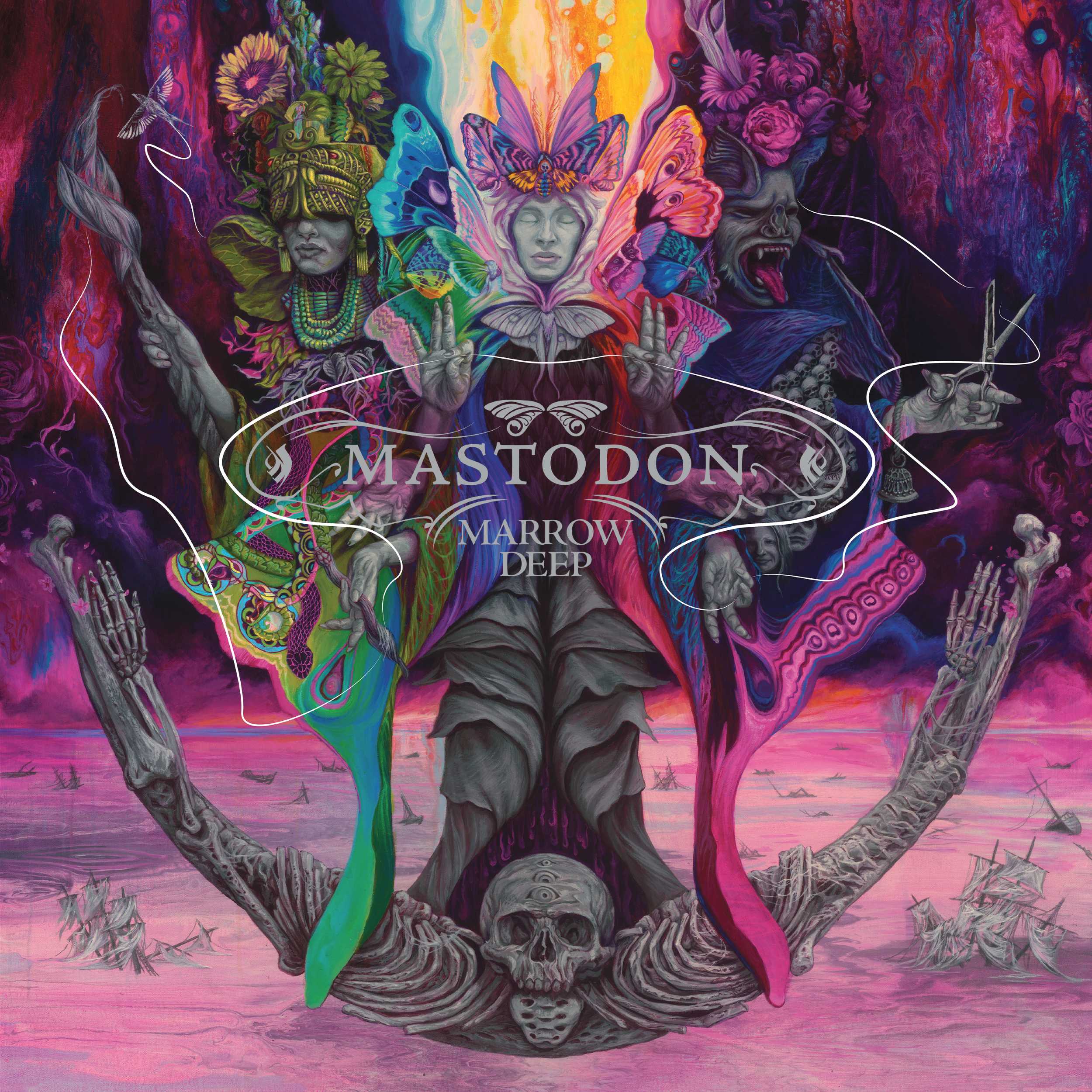
Mastodon ‘Marrow Deep’ album artwork
As a songwriter, what have you learned about yourself throughout the last couple of years?
“I’d like to believe I’ve learned, or perhaps confirmed, that I’m an overall good human being and friend when it comes to dealing with breakups, being honest with people and trying to remain rational, humble and fair. After a tragedy, you inevitably question yourself. Did I try hard enough? Did I offer enough help? Did I give the best guidance? After going over those questions again and again, I believe I did the best job a friend could do. I was as patient and compassionate as I’ve ever been with anybody in my life when it came to trying to help someone find a healthier and happier path. That’s probably more of a reaffirmation than something I learned, but I genuinely believe I did everything within my power. I think I can speak for Bill and Brann as well when it comes to the way we tried to navigate the breakdown of our relationship with Brent.”
Has everything that happened changed the way you approach life?
“I’m trying to become a better communicator because of everything that happened. Every time you lose somebody, it creates a reset in terms of humility, appreciation and perspective. I also reflect on the fact that I spent twenty-five years standing onstage beside one of the greatest rock guitar players on Earth. Within heavy music, our catalogue proves that Brent was one of the most unique and tasteful guitar players of all time. That makes me incredibly appreciative. We had far more ups than downs. In the context of twenty-five years together, the breakup was only a small blip. I’m not going to allow that moment to overshadow all the beauty we created and shared. If anything, it has deepened my perspective and made me focus more on the good than the bad.”
I wanted to ask about the film you released recently. What was the thought process behind making it? It almost feels like a film in two halves, with the first part showing four guys in a band and then a very different feeling after the VMA incident.
“We separated from Brent around February or March 2025. Then Brann’s mother died, we toured Europe, wrote a record and went into the studio, all while processing the sadness of the breakup and eventually Brent’s death. During that entire period, we never really spoke publicly about what had happened beyond the initial statement when we parted ways. We hadn’t addressed the subject properly for more than a year.
We felt it would be honest and fair to explain more broadly why the breakup happened without completely throwing Brent under the bus. We were simply trying to be honest with ourselves and with the fans who were understandably asking, “What the hell happened? Why did you fire Brent? Did Brent quit?” We wanted to clear the air because we felt everybody deserved that honesty. It was also something we needed to do before releasing the new single and album, so we could address it, put it into the world and then move forward.”
“I’m trying to become a better communicator because of everything that happened. Every time you lose somebody, it creates a reset in terms of humility, appreciation and perspective.”
When you first listened to the finished album, what emotions did it bring up? Now that you’ve had time to live with it, does it mean something different to you?
“With all the ups and downs, the light and the darkness, the writing and recording process, and the fact that we finished the album around ten months ago now, the main feeling I have when I listen to it is pride. I’m proud of the accomplishment and of the fact that all five of us came together and knocked it out of the park. Musically, it feels like the next natural step in the evolution of Mastodon and the journey we’ve been on. It doesn’t sound like anything we’ve done before, but it also doesn’t feel too far removed from everything that came before it. It feels like a beautiful step in the right direction.”
What do you think this record says about Mastodon in 2026?
“Unity. Perseverance. Happiness. Making it work. We have five people who are completely aligned with the same vision. So now is the time. We didn’t know whether we would be putting a record out this soon, but the stars aligned and we did it.”


Europe: “We’ve always said we should stay adventurous, do things the way we want and do what feels right.”

The Hu: “We love exploring the depth of our people and our way of living through our music.”

Behind the Board: Black Lounge on Capturing Imperfection, Instinct and Energy in the Studio

Blink-182 Release Limited Edition 7-Inch Vinyl Figures

GoDigital Music Expands in Asia-Pacific Market; Appoints Sebastian Mair as APAC President

Simple Plan Announce 2027 “Bigger Than You Think!” Canadian Tour Dates

Looters Celebrating 20th Anniversary at Toronto’s Bovine Sex Club

The Power of Superfandom: HYBE AMERICAS, American Express, Oreo, and THE·TEAM at Advertising Week NY


-
 Alternative/Rock1 day ago
Europe: “We’ve always said we should stay adventurous, do things the way we want and do what feels right.”
-

 Album News5 days ago
Connecticut’s Hard Feelings Drop Debut Album ‘No One Is Going to Save You’
-

 Album Review4 days ago
Nippa – ‘Homegrown’ [EP] [Album Review]
-

 Album News4 days ago
Dustin Kensrue Previews New Holiday Album, ‘That Spirit of Christmas’
-

 Folk/Singer-Songwriter5 days ago
Jon Rogalia Releases New Single “Her Smile (Before the World)”
-

 Metal5 days ago
Awake Again Unveil Pummelling Single “Middle Man”
-

 Album News5 days ago
Ernesto Cervini Quartet Announces New LP, ‘Water Pistols at Dawn’
-

 Album News5 days ago
Skepta Dropping ‘The Fork and Knife’ on November 6th!